Christian Girls Are Easy

The SAP had another chai-spluttering moment when he read that headline. Yet it is his fault, given he alerted me to a problem that appears to be invading church youth across Australia, possibly even the world. No-one seems to be getting any. And by ‘any’ I mean courting. Courting is apparently dead in the church. Caught between friendship with fellow female young Christians and wrestling with what’s written about scriptural purity, it appears there are scores of young Christian men frozen by indecision.

This is not good! It’s hard enough getting people along to church in this reaching, secular world. If all our young Christians end up so frozen by purity that they can’t even ask each other out for a coffee/cake/gentle get to know you, what chance have they got of ever getting together, tying the knot, and bringing lots of young baby Christians into the world?

I am reminded of the World War Posters – Christianity Needs You!Your+Church+needs+you

As readers will know, I’ve been longer secular than Christian. You really don’t want to know the full story of how my husband and I met. Suffice to say it had something to do with me getting my name on a plaque on a pub in Bathurst that required me to drink 100 pints of Guinness. Big T was brave enough to stand out from the easy-on-the-eye, yet conversationally challenged local stock and station agent with whom I had been attempting a dialogue. Big T plonked a diet coke down in front of me and the rest is history. I did still get my name on the plaque, though.

What I rarely share is that God has His hand on our relationship from the start. You see, as Big T walked into the pub, my housemate, who knew him already, pointed him out. It sounds like a cliche but I looked across the pub and it was like the molecules in the room shifted. A literal judder of the air. And no, I hadn’t had that many pints of Guinness! I hadn’t even made eye-to-eye contact with the man, but the impact was palpable. Then clear as a bell in my head: “That is an incredibly significant person in your life.”

I attempted to quickly converse with the conversationally-challenged local stock and station agent because I was freaking out! I was an enlightened, double-degree holding, career-minded woman whose predecessors had won her the vote. What was all this sappy, our eyes didn’t even meet across a crowded room and I was getting the shivers, business?

But God found a way. May have taken a while for me to cotton on (sorry God) but He found a way.

Based on the above, the lesson is that God really doesn’t need any help in bringing a spouse into your life. So get over worrying about that bit.

Yes, marriage is serious. But coffee does not equal marriage. It does not mean, “and with this latte/double shot/soy/skim cappucinno, I thee wed.” But you do need to at least make the effort to try out a few beans (am I using a really bad metaphor here, given everyone may now turn their minds to grinding?) to see if you blend!

You’ve got Christianity in common. Which I why I used the headline. Do you know how hard it is in the secular world to meet someone, fall in love, stumble through the ‘rules of dating’ (Lord, save me from the rules of should I call him after 3 days or will I look too desperate?), get married, have kids and then stay together when the reality sets in that the chemistry they unleashed during dating simply isn’t enough? There is such a thing as peaking too early.

Fewer people today think of marriage as a Christian institution. Oddly, it has become something to tick off the to do list. “I must get married before I’m 30..35..40..etc.” say many women. So, guys, listen to me when I write this: Christian girls ARE easy, because, if you are Christian too, you will already understand what’s in her heart.

Jesus is in her heart, right? So start with that.

There is so much I could blog on about: purity pledges being one. And I will. But, in the famous words of Napoleon: not tonight, Josephine. I have a headache.

Love The Lord With All My…..No, That’s Just Not Convenient.

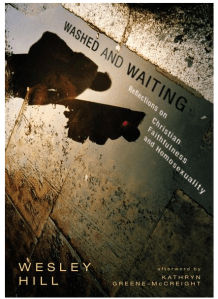
Washed and Waiting, By Wesley Hill.

I’m currently reading Wesley Hill’s book Washed and Waiting: Reflections on Christian Faithfulness and HomosexualityHill is a celibate, homosexual Christian. Given I often try to squeeze around the elephant in the room, I am interested in his perspective. The book wrestles with three main areas of struggle that many same-sex attracted (SSA) Christians face:

  1. What is God’s will for sexuality?
  2. If the historic Christian tradition is right and same-sex sex is ruled out, how should SSA Christians deal with any resulting loneliness?
  3. How can SSA Christians come to an experience of grace that rescues them from feelings of shame and guilt?

Hill does not advocate that it is possible for every SSA Christian to become straight, nor is he saying that God affirms SSA. Instead, Hill comes alongside SSA Christians and says, “You are not alone. Here is my experience; it’s like yours. And God is with us. We can share in God’s grace.”

While some authors profess a deep faith in Christ and claim a powerful experience of the Holy Spirit precisely in and through their homosexual practice, Hill’s own story, by contrast, is a story of feeling spiritually hindered, rather than helped, by his homosexuality.

Hill writes: Homosexuality was not God’s original creative intention for humanity— it is, on the contrary, a tragic sign of human nature and relationships being fractured by sin—and therefore homosexual practice goes against God’s express will for all human beings, especially those who trust in Christ. 

Hill is writing that it’s ok to be a SSA Christian. But it’s not ok, if you are a SSA Christian, to act on those desires and urges. If you’re not a Christian, have no faith or belief in Christ, then you can do whatever with whomever you like.

The SAP’s (smart alec pastor) angle is that it’s nothing to do with sexuality, nothing to do with doing whatever we like, and everything to do with needing to get to know Jesus better. But that’s why he’s paid to be a SAP (well, he’s paid to be a P, let’s be frank. The SA bit is a fringe benefit I’m sure some Archbishops get starchy about).

Anyway, every bit of my itchy before Christ (BC) skin sat upon me uncomfortably when I read the paragraph by Hill. Yet, given Hill is a homosexual celibate Christian, he has far more insight and knowledge into it, so who am I to get offended on his behalf?

That’s the problem. I feel offended because I feel I ought to. I’ve had a far greater secular life than a Christian one. The society I inhabit is all about ‘self’, and worships the popular belief that we as individuals know what is right, best and true for ourselves. My secular ‘BC’ self gets offended on Hill’s behalf because why shouldn’t he have sex with a gorgeous guy, thrive in a relationship, get married, have kids etc? Why, as his book outlines, is he walking the narrow path of celibacy?

What Hill is gently teaching me – and it brings tears to my eyes as I type – is that his faith in Christ is bigger than this world. He is choosing, radically, to put God and His word ahead of himself. His faith in Jesus commits him to a demanding, costly obedience of choosing not to nurture his SSA desires. Doing so, Hill encourages and challenges Christians with SSA desires to live faithful to God’s plan for human sexuality.

Not helped by different churches sending different messages. One pastor will encourage SSA Christians to live and love in Christ, have sex, be in relationship and come to his church (I’ll call him a populist pastor). Another will encourage SSA Christians to live and love in Christ, come to his church, but, like Hill, encourage them to remain celibate (I’ll call him a scriptural pastor).

The latter will walk with their same-sex attracted Christian friends, loving them well, picking them up, and making sure they are there for them in the same way they would for anyone else.

The former will tell their same-sex attracted friends that all is OK. That other Christians are wrong in interpreting the scripture. That God was mistaken and the Bible is incorrect. That Jesus is all about love.

The latter will worry about the souls being taught by the former, because, as Hill comes back to again and again in his book, it’s not homosexuality but homosexual acts that the Bible lists as a no-no. So the scriptural pastor is counselling based on the Bible while the populist pastor is counselling based on popular, modern-day cultural expectations that ‘we know best’ – revolving around the importance of ‘staying true to self’. I have desires and I can act on them.

The scriptural pastor will be in anguish because he believes the populist pastor is leading SSA Christians further away from Christ. And wouldn’t that just piss you off come his return?

I use the word ‘anguish’ on purpose. The scriptural pastors I meet aren’t narrow-minded, bigoted homophobes. They are desperately saddened and anguished because they believe, with all their loving hearts, that to ignore the Bible (not just on this subject, but on anything) is to lose the way back to God.

For them, there’s a lot of really serious stuff at stake. As Jesus explains in the Parable of the Weeds: this separation from God – Hell – is like ‘a blazing furnace, where there will be weeping and gnashing of teeth.’ (Matt 13:40-43) and again a moment later in the parable of the fish in the net, (Matt 13:49-50). A Christian does not wish that upon any soul alive. Which is why they share the message of Jesus. Not to judge or accuse. Rather so as many as possible can come to know and trust in Jesus, and be kept safely away from the weeping and gnashing.

Trouble is, it all goes pear-shaped because humans are involved. We are flawed. No Christian is perfect and in trying to explain all this it often gets narrowly interpreted or blown out of proportion. This is an incredibly emotive and difficult topic to write about. It’s easy to be misrepresented and misunderstood. I’ve skittered around it for months.

If I had the answers, then my name would be Mosette and I’d be standing on top of a mountain taking dictation. I can only offer the following observations from my meditating on this for over a year:

1) Some Christians unhelpfully muddy the waters around sin. I have heard UHT Christians (those who have been at Christianity a long, longer life than I) use terms of condemnation around the Mardi Gras march. But where’s Jesus in that? The same Christians rarely talk pillars of salt when faced with an unmarried heterosexual couple having sex. So why make a ‘bigger sin’ out of SSA and mardi-gras? An unmarried heterosexual couple, having children and living together are just as sinful to God. Yet how often are they called out as an example?

2) The Bible isn’t comfortable reading. But there are two really important lines. As a new Christian I battle my way through the scriptural stuff on the topic. The Bible isn’t a flat set of rules I can read objectively and apply unilaterally. It tells me of God’s complex interaction with humanity. It’s a complicated, and at times troubling, holy text. It has more than one voice. It contains letters and laws. Poetry and proverbs. Prophecy and philosophy. Often, probably like many others, I find myself more called by what I want the Bible to say than what it actually says.

Personally I rest on this: Jesus said all the scriptures can be rendered into two commands: To love the Lord with all my heart, soul, mind and strength, and to love my neighbour as myself. Jesus is about love, but he was incredibly specific when teaching how to direct that love. To love the Lord first.

3) What does loving the Lord really mean?  Wesley Hill has chosen to love the Lord with all his heart, soul, mind and strength in a way that my secular, selfish, self-led perspective would never have understood prior to my Christian journey. Now, though? I am awed and humbled by his decision. To give of yourself; more, give over yourself so totally? To love and honour God’s call above all earth-bound needs and desires? It’s a huge commitment that demonstrates Hill’s immense trust in God.

4) Biblical truth is rarely popular or palatable. God’s word can be uncomfortable and inconvenient in a society that puts self first. Which is why you have such a striking difference between what populist and scriptural pastors teach. As a Christian, I need to look closely at my own heart and discover if I am motivated by what I want the Bible to say than what it actually says. Because if I only take what I want it to say, massaging it so I find it more popular and palatable, then I am putting myself first. I become God in our relationship. And that never works out too well.

5) Love always protects, always trusts, always hopes, always perseveres. After all, Jesus persevered for us no matter what. He was faithful no matter what. Hill is trusting, hoping, persevering. He is sticking to what God asks of him because, even though it is not popular or palatable, it is what God asked – commanded – of him. Loving obedience is the crux of our relationship with God and trust in Christ.

That love line is pesky isn’t it? In our self-directed, secular world, we are told ‘all we need is love’, that ‘love is enough’. Yet love without protection, trust, hope, perseverance, truth and grace? It becomes hollow. A sound-byte. A hall pass.

6) God’s truth can’t be convenient only when I need it to be. God packed the Bible full of inconvenient truths. But performing bible-reading gymnastics, to make those truths more palatable, can have an awful impact. Like headship. Some Christian men have perpetrated domestic violence by reading ‘submit to your husbands’ as some awful permission to abuse. Playing God in their relationship, they ignored the instruction ‘love your wife as Christ loved the church’. Yet, for their wives, and the clergy who help them, the ability to turn to that final, ultimate scriptural truth is, for many, a literal lifeline. Imagine if it could be ignored. So I love how the Bible, and Jesus, gives a clear directive on this one.

Ah, right. So I sometimes only like the truth when it suits me and my beliefs, my desires. Which then makes it all about me, not about Jesus and God.

But this, ALL of this, from Bibles falling off shelves, to being pursued by an impatient Hound of Heaven, to getting the courage to be Lipton’d in the river, to hold up all my secular beliefs to scrutiny and be challenged – it’s never been about me. It’s always been about G & J. It’s had to be. Otherwise I’d have stopped a long while back.

So in my relationship with them, I just pray that I may bring but a small measure of the courage, faith, commitment  and strength shown by Wesley Hill. That God will save me from convenience, from reading only what I want to read. And that I may always love with protection, trust, hope, perseverance, truth and grace.

Amen.

Highway to hell or stairway to heaven?

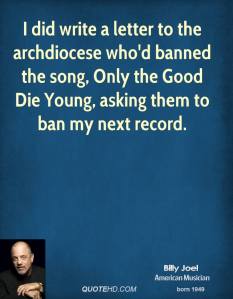
As Billy Joel sings in Only The Good Die Young, why go to heaven when all the sinners, who obviously know how to party, will be having a blast? Stop hiding behind that stained-glass curtain, he tempts young Virginia. What respecting young virgin could resist the sax of Billy? Heaven, to my teenage thinking, would be full of boring souls who didn’t know how to have a good time. Hell, on the other hand, would be the venue to party. billy-joel-musician-quote-i-did-write-a-letter-to-the-archdiocese

Quite early in our email discourse, as I wrestled with G&J, the SAP wrote that I needed to tell the devil to rack off. I remember reading it with narrowed eyes, as we communicated via the very modern trappings of the 21st century, wondering why we getting, to my mind, all dark ages. ‘Christians don’t seriously believe in hell and the devil, do they?’ I wondered at the time.

In 2003, a research group found 64% of Americans expect to go to heaven when they die, but less than 1% think they might go to hell. Over a decade later, I wonder if those numbers have changed. Not only are there plenty of people today who don’t believe in the Bible’s teaching on everlasting punishment, even those who do find it an unreal and a remote concept. I was the same.

Yet hell is an important part of the Christian faith. If you’re going to embrace the grace of Jesus, then you’re going to have to grab the asbestos cloak and do some fire-walking into hell too. After all, Jesus taught about hell more than any other author in The Bible. Yep, the author of grace, the embodiment of compassion and forgiveness taught about a person going to “hell [gehenna], where ‘their worm does not die and the fire is not quenched.’ Jesus is referring to the maggots that live in the corpses. When all the flesh is consumed, the maggots die. Jesus is saying, however, that the spiritual decomposition of hell never ends, and that is why ‘their worm does not die.’ (Mark 9:43)

So if Jesus spoke about hell more often, and in a fairly vivid, blood-curdling manner than anyone else, it’s not something to ignore. So what is hell?

Virtually all commentators and theologians believe that the Biblical images of fire and outer darkness are metaphorical. That certainly wasn’t explained clearly to me at my school. As a result, as I grew older and began to think and question, I couldn’t imagine some ‘place’ where fires burnt eternally.

Paul describes the everlasting fire and destruction of hell as ‘exclusion from the presence of the Lord.” (2 Thessalonians 1:9.) Separation from God and his blessings forever.

CS Lewis’ description is one that captured me more than any scenes of fire and lava. ‘Hell begins with a grumbling mood, always complaining, always blaming others . . . but you are still distinct from it. You may even criticise it in yourself and wish you could stop it. But there may come a day when you can no longer. Then there will be no you left to criticise the mood or even to enjoy it, but just the grumble itself, going on forever like a machine. It is not a question of God ‘sending us’ to hell. In each of us there is something growing, which will BE Hell unless it is nipped in the bud.’

Now THAT scares me. Unlike my teenage imaginings, hell isn’t going be filled with sinners who know how to party hard. Instead, hell is a soulless world filled with constant whining, complaining, blaming and hating. It’s humanity’s separation from a loving, giving God who marks us with his grace in the gift of His son, and ‘sings over us’ in his joy. It is living life our way, our terms, our choices. Separate.

Yet we all have a choice about what we say, how we think, what we do. Creating hell on earth, to my mind, is literally the quality of our next thought, word and deed.

imagesThere’s a reason why ACDC and Led Zepplin sang about a highway to hell and a stairway to heaven. Sitting in the outside lane on a speeding highway, it’s easy not to think. Set the cruise control and forget. No need to engage the brain. Dumb it down. Disengage. What could possibly go wrong?

The stairway to heaven is slower, takes a little more effort, a little more awareness about qualities and behaviour. Daily I give Him thanks for how God glories in my slow steps. While His grace within me may be one of a ‘million million doors in this world for His love to walk through’, my flawed humanity often forgets to keep that door open. Quite often it’s a case of trapping my (or someone else’s) finger in the door, or slamming it shut as a I stomp about short-sightedly.

Thankfully, climbing a stairway reminds me to look up and look around. Take a breath. Even dance along each step and glory in the joy of the journey. Sometimes hard to remember, but far more fulfilling than cruise control ‘set and forget’.

No victims or survivors here, move along

How does one follow a couple of blogs on family violence (FV) and safe ministry?

Carefully. Nothing-to-see-here-630x286

Before I return to blog posts poking fun at myself on this Christian journey, I wanted to share a couple of lessons that have popped up for me in the responses to both.

I am not a victim. Please let’s stop using that term.

Yes, I may have been harmed or injured as a result of family violence. But I am not a person who has come to feel helpless and passive in the face of misfortune or ill-treatment. Whilst I was physically sick after publishing that post, it wasn’t from any feeling of helplessness. Instead it was because I dreaded someone looking at me differently in the present day. Treating me differently. Like a victim. To be named a victim is to somehow remain stuck in the language of fear.

Nor am I a survivor.

Gloria Gaynor has a lot to answer for. Surviving something feels so limiting. Slightly static. I don’t continue to live or exist in spite of FV. In fact, I rarely think about it. Why survive when you can bust through and grow?

Show compassion, sorrow or anger on my behalf, but, dear God, don’t pity me.

The parents who split messily, the mother who attempted suicide, the step-father who used his fists, all those experiences made me the woman I am. Whom I love. A resilient, strong, sassy, kind, fun, loyal warrior. Sarcastic, dry-humoured, yet compassionate and empathetic. (The latter two are less my default feelings. Thankfully Jesus reminds me to access them more each day). So please don’t pity people for the very experiences that forged them. If they value what they see in the mirror, your pity only devalues the experiences that gave them worth.

Love, forgiveness – ‘turning the other cheek’ – can achieve miracles.

Rosie Batty responded to a hateful, vile act with love. As a result she placed FV far higher on our nation’s agenda and was instrumental in the instigation of a Royal Commission into family violence. It’s early days, and I look forward to seeing how our leaders and our society as a whole tackles it.

There’s more to do, to pray for.

Yes, call for increases to budgets for family violence support services. Safe havens are necessary. But rather than parking the ambulance at the bottom of the cliff as abusees tumble over, let’s start fixing the underlying issue: why men (and some women) perpetrate family violence. What messages are being sent in our culture that perpetrate it? That cause confusion? Such as:

  • We tell our boys it’s never okay to hit a girl. How often do we teach our girls that it’s never ok to hit a boy?
  • Advertising that portrays women as passive objects that any amount of muck can be done to.
  • Porn. Rape porn.
  • Laws that leave Fathers battling for fair access visits to their children, with little recourse. Yes, there are times when that limited access is necessary. But (and I write from personal experience) there are also times when good men, great Dads, are punished by their ex-wives for the relationship breakdown; via making access visits incredibly difficult to secure.

This isn’t going away.

Ending family violence requires massive societal change; results need to be measured across generations. I’m impressed by the many clergy who have been vocal in calling for change and appear willing to shine the light in the dark corners. I’m also hopeful because of another massive societal shift that spread across the world incredibly quickly, back in the first century, and continues to support the weak and stand up for the oppressed today.

Seriously? We’re asking how a church can model love, trust and respect?

Thank-you. For the heartfelt support that poured through social media and across email in response to the blog about my experience of family abuse as a child. I heard from old school friends who were horrified they did not know. Teachers who wanted to know what signs they had missed. Other victimssurvivors, valiant warriors.  And Christians, so many, who urged me to keep going. To push strongly the importance of safe ministry, domestic violence and educating the clergy.images-1

I don’t know. I hit publish then crept away and vomited. I wasn’t strong. I’m wobbling along on Christian training-wheels here, let alone some domestic abuse specialist with insight into ministry.

The irony, only 48 hours ago, after battling with a sermon on using our spiritual gifts, I typed one of my usual, polite, requests for Christian guidance to the smart-alec pastor: ‘I honestly just bash my head on the keyboard and say to GJ&HS, much as I did at 3am that Easter Monday, “WHAT? What on earth did you chase me down for?’

I then (foolishly) added: ‘Will ask God to let me know clearly. And maybe to use some really distinct voice/accent.’

Well, less than 24 hours later, I heard lots of voices. Strongly. From all of you. How can I ignore voices such as these?

I’ve been involved in a fairly intense debate with a bunch of Sydney Anglican ministers (all men) on this very topic for the last few weeks. I’ve seen some commentary over the last few days acknowledging the issue and saying they need to do something about this, and that a woman should never stay in this kind of situation. They are a very influential voice in the life of this city and getting them on board is a worthwhile exercise, even though I’m sure there’s many who’ll choke on their coffee right now while reading your blog.”

From others, who acknowledged it was their pastor and their faith that got them out their situation, and gave them the strength to rebuild.

And others who had lost faith in the world and were desperately seek a rebuilding: “Phil, go tell those ministers this… God is love, forgiveness and peace. A true man loves his wife, children and life through and with God. Any man that abuses or violates another human being is lost from God and needs help. Women and mums stay hoping it will change or waiting for the best moment to get out. When we do get out, with our children with us, it takes a lot to rebuild faith and trust in humanity. Fixing this starts with listening, acknowledging and working with everyone…. We all suffer from the destruction of it and it needs to stop. As men leading churches… teach men what it takes to lead a family through leadership, personal responsibility, love, forgiveness and peace. Teach the women how to value themselves as the goddesses and glory that they are. We need honour back in common conversation, behaviour and action. Teach honour and model honour, love and respect in the churches and community at large and then we have a great place to start.”

Finally, sadly and scarily:

“I used to work for a church based counselling service and I ran groups for male perpetrators of domestic violence, kids who witnessed DV and I had behind the scenes involvement with groups for women who had experienced DV. Many counsellors can tell you stories their clients have shared with them of the subtle and overt pressure to endure whatever crap they were experiencing for the glory of Jesus. I’ve had clients who have made themselves very very sexually available to their husbands despite their own wishes because it was their ‘Christian duty’. Most counsellors who deal with Christians can name you men in leadership who are engaging in some form of abusive behaviour but the system is so supportive of them no one will speak up.”

I love my church. Its community has offered me renewal in times of trial. But the overall system of the ‘Bride of Christ’? I dare say it’s as packed full of politics as parliament. The response over the years to dealing with abuse has not been the bastion of truth, justice and mercy one would hope. So the light needs to shine. Light disinfects.

As a new Christian, I don’t want to have to defend my faith. I want to smile and uphold it for the source of joy it is. To say, “How awesome is it that faith and church helped a woman leave an abusive marriage?” rather than be caught in a war of doctrine around ‘submission’ ‘headship’ etc. I don’t want to watch a wave of stories come out about Christian leaders engaged in abusive behaviour that has been been covered up.

Clean out the dark corners. Be less parliament (pharasees anybody?) and more Jesus.

As the comments came in, I kept going back to one in particular: We need honour back in common conversation, behaviour and action. It was a familiar echo of something I had read before, I just couldn’t put my finger on it.

Ah, yes, that big book called The Bible.

  • Finally, brothers and sisters, whatever is true, whatever is noble, whatever is right, whatever is pure, whatever is lovely, whatever is admirable–if anything is excellent or praiseworthy–think about such things. (Philippians 4:8)
  • Live such good lives among the pagans that, though they accuse you of doing wrong, they may see your good deeds and glorify God on the day he visits us. (1 Peter 2:12)
  • They could find no corruption in him, because he was trustworthy and neither corrupt nor negligent. (Daniel 6:4)
  • In the same way, let your light shine before others, that they may see your good deeds and glorify your Father in heaven (Matthew 5:16).

Can someone in church hierarchy please stop for a moment and think: “Hang on, people are asking us to teach honour, and model honour, love and respect in our churches? Shouldn’t we be horrified that so many people believe that’s not actually the case?”

Church doctrine & domestic violence. Stop blaming. Start fixing.

41646jpgVeLBefore I turned fourteen years old, I had defended myself with a knife against a forty-something year-old male who liked to use his fists in places it didn’t show.

I had watched a tea-tray thrown from the top of a three-storey house because his cup was not placed on it – and it wasn’t a leap of my imagination to suppose he would push my mother out too.

I always, always invited people over to stay on the weekend. Because then, possibly, the man of the house, this second husband who professed love for my mother, would keep his societal mask in place and keep his fists off her.

One night I crept downstairs to see her crying in a chair. She said to me: “What will I do if he hits me again?” Again? My brain could not compute that she did not have an answer. All that I saw, every school anti-violence message, every teen-pop magazine I had read told me one thing: there is always an again. No matter the tears, the apologies. So the answer was quite clear: “We leave,” I told her.

Yet still it took months – I suspect now he had her financially isolated – and in the time between my articulating it and the reality of our departure, I lived in a ratcheting high tension.

My grabbing that kitchen knife was a turning point. Perhaps my mother saw murder in my eyes and finally, finally, saw the motivation for change. A 6′ 6” (198 cm) bully turning tail, scampering up the stairs, locking himself away in the bathroom, with me, far shorter, far lighter, in pursuit. After rattling the door knob for good measure, I went back down the stairs, calmly put the knife back in the knife block and walked to school. Shortly after my Mum and I moved in with friends.

All this whilst attending an prestigious private school, where no-one had a clue. He was a fine, upstanding Rotary club member, after all. We were acting out the perfect blended family.

I can’t speak for my mother. I have no idea why she stayed, and why I, the child, had to encourage her to leave. Why it took teenage fingers wrapped around a carving knife hilt to prompt action. What I know is this: as soon as people knew, we were helped and supported. Which is why the recent finger pointing at church institutions for ‘condoning’ domestic violence, for encouraging wives to stay with abusive husbands through some warped reading of ‘biblical headship’ has pressed a few of my buttons.

If a pastor has ever intimated you should stay, he is wrong. For anyone who points to ‘wives, submit to your husbands’ as a biblical directive to stay in an abusive marriage, please respond: ‘love your wife as Christ loved the church.’

All the pastors and Christians I have met in the past year would be helping you pack your bags and more. God certainly does not wish for you to stick it out. As  articulated in 2012 (bold type is mine):

“While the Bible calls upon the wife to submit it never calls upon the husband to subjugate or subdue his wife. It is never his prerogative or responsibility….All forms of coercion—physical, economic, social, psychological, spiritual—are inappropriate and wrong for a husband to use on his wife. Some, such as physical abuse, are criminal and should be dealt with by the courts. The Christian husband’s duty and solemn vow is to follow the example of his Lord and lay down his life for his bride. This will always put her interests before his own at whatever cost it is to him. This will mean never using or even threatening force. To subjugate his wife is a complete denial of what he promised.”

There is no reason to believe that the rate of family violence within Australian churches is any lower than in the general population. It is the leading cause of death and injury in women under 45. The Easter period last year marked the deaths of six women and children in a single week. One in three women is affected by family violence, one in four children, and one woman a week dies.

Please re-read my bold type above. Coercion rarely starts in the physical. It’s the wearing down – “you stupid cow, can’t you even sort the laundry properly?” – the gradual, dangerous dismantling of a woman’s sense of self-esteem. My step-father would be apoplectic over a coloured shirt in the white wash.

Physical violence is the escalation. Your husband or partner may never have raised his hand against you, but if you spend many hours of the day thinking about how he might possibly react to everything you do, second guessing how some of life’s simplest choices might upset the balance at home? Get help. Plus – as I chillingly read in another article on family violence – if you are reading this, recognise these signs and share a computer with your husband or partner: please delete your browsing history.

Abusers abuse. To blame it on Christian doctrine narrows the lens too dangerously. As does saying it could never happen in a church.

If you or someone you know is impacted by sexual assault, family or domestic violence, call 1800RESPECT on 1800 737 732 or visit www.1800RESPECT.org.au. In an emergency, call 000.

Can I Take This Elephant To The Mardi-Gras?

Rainbow-elephant-2I feel a bit like a stranger has stomped through my soul wearing a hefty pair of Dr. Marten boots. I’m not quite sure how it happened, or even if I can point a finger at one particular interloper, but, to describe it in very female terms, I feel like my faith is suffering from PMS.

Mood swings. Irritability. Tiredness. A desire to inflict blunt instrument trauma. Itchy in this Christian skin. Why now? I’d floated on post-liptoning life into Christmas, gently enjoyed the eddies and flows of a reflective January, and arrive truly excited for growth both spiritually and professionally this year.

Yet I feel like my soul has broken out in hives. That from last year’s happy dance over reaching some Christian summit I’ve just looked up and seen a mother of a mountain. My faith is acting like a petulant teen. It wants to stomp its feet, head back down the mountain and get completely blind on apres-climb liquor.

“I don’t want to read a useful Bible verse and pray to feel better,” it whines at me. “Pass the vodka.”

Is it really my faith whining petulantly or an echo from my 42 years ‘before Christ’ (BC)? From re-arranging my molecules whilst holidaying with an old friend who knew me BC yet hadn’t seen me ‘after Christ’ (AC), to something as simple as sex, I am suddenly cranky, restless and resistant. My New Christian Dr Jekyll is being challenged by my older, less Christian Hyde.

BC/AC

Sadly, the old friend with whom I holidayed is not on social media. This blog and my whole hound of heaven year had gone unnoticed. A passing comment that I’d been attending church led to long aethist viewpoints. My Liptoning in the river left her speechless. The adjective ‘God Botherer’ was used. As I smiled and held onto patience, my Hyde began to itch.

Simple as Sex

If only sex was simple. Trouble is, it’s tied up in values, beliefs and religiosity. My many years BC have given me some fairly open-minded views about sex, that don’t necessarily sit well AC. Take 50 Shades Of Grey, currently on billboards as the movie approaches. Where does Christianity sit with the 50 Shades genre? After all, Christians have sex. Some of them, after prayer meetings, even commit to having sex with their husbands every day for a year. Yet sex with pain and humiliation? Books that ‘normalise’ using sex as power? Suddenly there’s no grey. Kim Gaines argues that the lens of Fifty Shades delivers an unrealistic view of sex and power while Christian sex therapist and doctor, Patricia Weerakoon warns Christians to stay away from the movie and the books, given it normalises “unconventional sexual behaviour”, including bondage, discipline, sadism and masochism.

My BC Mrs Hyde rolls her eyes and wonders what the fuss is about. It is fiction. If you’re a consenting adult and you’re daft enough to sign a contract with a billionaire who has S&M proclivities, then you know what you’re in for. I repeat, it is fiction. If you read it and take from it an unrealistic view of sex and power then, I would venture to say, as it is fiction, you had an unrealistic view to start with.

Yet, I can’t simply ignore Christians’ concerns because – and this is where my faith starts to whine petulantly – I did opt in with the whole baptism bit. It holds me accountable despite any nagging wishes to hide behind Christian-ish.

I realise some of my itching and wriggle-room seeking is because, if I challenge it on Fifty Shades, there’s nowhere else to look but at the elephant in the room that is the Christian view of sex. Within a loving, heterosexual married relationship.

The elephant in the room – everything else outside of this view, including same sex marriage and same sex sex – derails me often. The fuss about Fifty Shades has me standing in front of the elephant again. Wondering if I want to run away with it and join the circus. Or Mardi Gras. Oh, boy. Or girl.

(The irony that I have no wish to be tied down to exploring sexual mores when discussing Fifty Shades, by the way, is not lost).

The SAP once pondered why God hunted me down. I replied perhaps He wanted me to lead the change-communications campaign for the church and same-sex marriage. Crickets chirped.

There are churches that would wrap my elephant in rainbow colours and lead it in a mardi gras. It would make me far less itchy in this AC skin. Trouble is, my elephant and I keep coming up against pesky scripture and Jesus’ line: “I do not condemn you…Go and sin no more.” John 8 1-11.

So whilst the Bible does give a clear answer about my elephant, the answer is not to Mrs BC Hyde’s taste. She’s pulling the ‘salt, tequila, lemon’ grimace. Dr AC Jekyll? Well, she fancies lining up a few shot glasses herself in commiseration.

I have climbed high enough on this Christian mountain to understand I do my faith a disservice by seeking a hall pass on this. As well as feeling I insult ‘qualified’ pastor types, regardless if they wear smart alec stripes or not, who are honest enough to stick to biblical truths no matter how challenging and unpalatable they are in the modern world. Doing so turns me into my BC/AC friend, who tried to impose her views over my new faith to make it more palatable to her.

The elephant will always itch at my skin. So whilst I can’t climb over it or squeeze around it, I will instead keep pressing my forehead lightly to its trunk in prayer.

What would you do if you were truly fearless?

imagesI’ve never been much of a goal setter. I am incredibly thankful for the personal or business achievements in my life to date, but it kind of all happened ‘by accident.’ I was too young to know better (hello, 25 years old, and my first client was a multinational offering a monthly budget that I had earnt as a journalist in six). I somehow then accrued the business skills to sail through the subsequent years, build up a good sized PR agency, generate profits and employ people.

Then, after my spiritual Christian explosion last year (the whole hound of heaven, G,J and the Holy Ghostwriter, getting dunked experience), everything came into sharp focus.

This is not about me. Yet I have a part to play. It’s a decidedly liberating feeling to humbly acknowledge God and Jesus have the reigns, while honouring the words: Ask and you shall receive. 

What would you do if you were fearless?

No-one is fearless. Our fears are vines that twist around our legs as we attempt to step forward. They are the whispering voices in our heads that undermine our hopes and dreams. Yet think for a moment. Do you fear the ‘thing’ you are scared over? Or is it actually the feeling of fear that has power? Example: I never set goals in my first business for over a decade because, well, what if I didn’t achieve them? What would that failure say about me? I did OK without them, after all.

Setting goals isn’t scary. It was my fear around having those goals on show for all to see and not reaching them that paralysed me. Cleverly helped by my excuse that I did OK without them anyway (ahem, my dear Psych Nemesis would probably call that denial).

Yet, it is a waste of God-gifted talents not to set big, hairy audacious goals and dare greatly to achieve them. Each of you should use whatever gift you have received to serve others, as faithful stewards of God’s grace in its various forms. 1 Peter 4:10.

So I am currently referring to G,J & HS as the divine business management team (DBMT) because without my faith in them I’d not be dreaming so big, and daring as greatly as I am this year and beyond.

I have goals. Big ones. They are daunting and – because God has a sense of humour wiring my brain for warp speed – on a rigorous five-year schedule. I have a business coach to keep me accountable. It is out for all to see. I am the business chick stripped bare.

Yet, stripped down, I feel unencumbered. Able to fly. Paradoxically, given I have more on my ‘to do’ list than ever before in 15+ years of business ownership. I have a lightness that comes from faith that my true CEO has it under control: Now to him who is able to do immeasurably more than all we ask or imagine, according to his power that is at work within us – Ephesians 3:20.

I’m certainly not fearless. Far from it. In fact, before I paid the deposit on my business coaching I was almost paralysed with the uncertainty. So I called a quick board meeting (prayed). “You think you’re in fear,” Jesus said. “Try being me in the Garden of Gethsemane that night.”

Nothing like a dose of perspective. It shoved down the jitters sufficiently for me to step out of my comfort zone and look at the next vista.  Which is the true comfort of faith. With it, I can dare greatly. As the song goesI am brave when I am on your shoulders. You raise me up to more than I can be.

2015: My Year Of Living Vulnerably – No bluffing!

I had occasion just before Christmas to have a psychologist dig in my brain. A comms pro who spins words, and a psych who reads words for nuance are always going to make interesting jousting partners. bluffing-300x300

I call it a dislike of navel gazing, he named it denial. Ouch.

I call it independence, he named it an unwillingness to ask for my needs to be met. Ouch again.

I call it creativity, he termed it hiding behind the keyboard and being unwilling to be vulnerable in ‘real life’. Ouch thrice.

I call it dry wit, my nemesis suggested it was avoidance: the chance to take a deep in-breath while i laugh, in order to settle myself rather than cry.

Well, it was an enervating hour, giving me plenty to ponder throughout the Christmas period. In a knee-jerk “how dare he tell me I’m not vulnerable?” response, I also devoured Dr. Brene Brown’s ‘Daring Greatly: How The Courage to be Vulnerable Transforms the Way We Live Parent and Lead.’

By the end of the book, I think my nemesis was half-way wrong and three quarters right. Half-way wrong because I identify with Brown’s vulnerable ‘wholehearted’ people in her book from the perspective of my own resilience. Yet three-quarters right because by the end of the book I had come up with a new diagnosis, one that Brown doesn’t touch on, promoted by my hour with the psychologist. The vulnerability double-bluffer.  I suspect there are lots of us out there.

The vulnerability double-bluffer does honesty well. We don’t anxiously overshare, thanks to resilience, and due to independence we do not seek to to drag others into our story. But here’s the double-bluff: we give out our ‘medal’ vulnerability stories, the ones we have won over and made peace with, made acceptable, and we shine them up like medals pinned to the chest of our soul. We double-bluff ourselves that we have been vulnerable, when instead we have merely shared the echo of vulnerability. Yet that echo is enough for our audience, our friends, our loved ones, and, dangerously, often ourselves – sucked into the double-bluff. If it walks like a dog, looks like a dog, barks like a dog, then, yes, it’s probably a dog.

Vulnerability double-bluffers are good at it too. We can spit out vulnerability medal stories to you face to face, across an audience of hundreds, or via a blog and receive compliments about how raw and open and honest and vulnerable we are being. Yet to share only the medal vulnerabilities whilst telling ourselves we’ve just been truly vulnerable? What are we cheating ourselves out of?

Back to Dr. Brown’s book. She challenges the cultural myth that vulnerability is weakness and argues that it is, in truth, our most accurate measure of courage.

Brown explains how vulnerability is both the core of difficult emotions like fear, grief and disappointment, and the birthplace of love, belonging, joy, empathy, innovation, and creativity. She writes, “When we shut ourselves off from vulnerability, we distance ourselves from the experiences that bring purpose and meaning to our lives and our work.”

The danger being a vulnerability double-bluffer means we think we are being brave, we think we are displaying courage – and to all intents and purposes we are –  but we’re actually not digging deep enough to truly feel it. Imagine dipping a bucket into a well and it coming up half empty. Double-bluffers need to dig deeper. To get the full bucket of love, belonging, joy, empathy, innovation, and creativity that vulnerability delivers. Double-bluffers have to admit they are only sending the bucket down halfway.

The only person I am truly vulnerable in front of is God. With Him there are no shiny vulnerability stories to hide behind. As I have walked along this new Christian path I have learnt the more vulnerable I become with Him, the closer He draws. To paraphrase Augustine, God made me for himself. And the more He gets of me, the more vulnerable I become in front of Him, the stronger our relationship grows.

“Those who love their life in this world will lose it. Those who care nothing for their life in this world will keep it for eternity.”  John 12:25.  Jesus is talking about a life in which we make ourselves vulnerable – to God and others, even to those who reject us. Pouring out ourselves for others unconditionally, and trusting God to fill us back up.

So if I can have this incredibly close, personal, awe-inspiring, miraculous relationship with the flipping creator of galaxies beyond my imagining, whose love for me is immeasurable and I receive all this stunning amazingness by being vulnerable – well, imagine what being vulnerable can do to my small, contained life and the relationships within it?

Which is why 2015 is my year of living vulnerably. No bluffing. No folding. No matter the cards.

Grace Holds.

This post starts after the Lindt cafe Sydney siege and the breaking news today that eight children have been stabbed to death in Queensland. One as young as 18 months.

It starts less than 24 hours after our quiet, leafy suburb was teeming with police and their dogs, searching for the person who chose to hold up our local liquor store, threatening the young bloke behind the till with a needle injury.

https://www.youtube.com/watch?v=7TvHrzQJ0NE

Yesterday I suggested on social media that our local community buy a case from the local bottle shop today. Small scale #Illridewithyou. Today I went in and my heart was gladdened to hear the owner say how busy she was. Thank you community.

Today I sat in our local cafe next to our Como institution. Close to 90 years old, Mrs R lives independently – my family first got to know her almost ten years ago when I walked past her house with my newborn son. She had a quiet tear today thinking about how long she has lived in this peaceful suburb and how distressing it was to hear the news of yesterday’s robbery. After she left, the cafe regulars worked out how to make sure she was tended, to offer her love and comfort, without intruding on her independence. Thank you community.

It would be easy for me to say, after the events of the past week, that it appears God has turned his back and shut the door on our bewildering world. But then I see Jesus in each person who bought a case of wine or beer from our local bottle shop today. In the compassion that strews Martin Place with flowers. In the love that tends to a 90 year old woman to ensure she is held safely in our small community.

Grace holds.

Grace