Me? You talkin’ to me?

It all started with a job interview. I failed one of the essential criteria quite spectacularly, so much so that I’m surprised they even interviewed me. The criteria was practising Christianity.

I figured I was a fairly Christian person. So I only went to church at Christmas, but in terms of being a ‘good’ person, I thought I did OK. In terms of the job, I blitzed the rest of the criteria. So would skill-set trump spiritual-set?images-1

Not. A. Hope.

Not a pleasant feeling either.

My ego had been pricked. The very essence of what I could do was negated by what I was not.

So, like most scorned women, I took myself off for a long weekend with some pals to drink wine, eat chocolate, bitch and drink some more wine. That’d sooth it.

But despite the venting, I wasn’t soothed. Instead, I experienced a none too subtle spiritual shoving that, no matter how much I dug my heels in, pushed me closer and closer to unpacking everything I thought I knew about spirituality. I’ve blogged about the dream on Mum’s funeral morning that gave me much needed comfort. How I could ignore what was going on right now if I wanted to hold my faith in that sign? I couldn’t have it both ways. 

I have experienced too many small miracles in the past to ignore what went on that weekend: The Bible falling off the shelf at my feet at the Great Mackerel Beach communal library – with no one nearby to cause it fall. Or the yacht at Palm Beach, the sail unfurling, emblazoned with the words ‘Mister Christian’. Awaking with Jennifer Warnes’s ‘Song of Bernadette’ playing over and over in my head each morning when I had not heard her music in probably a decade.

So, finally, I surrendered. My conversation with God (3am, bolt upright in bed) went something like this:

Phil: Ok, ok, I’m listening. Enough with the signs and interrupted sleep already. What?

God: Work it out. Sort out your faith.

Phil: Yeah, right. Dreams and signs. Plus my way to Christ and faith is more Mary Magdalene meets Oprah’s Super Soul Sunday than Virgin Mary and Sunday school.

God: And your point is? Aren’t you the one who strives for non-judgement and unconditional love? You’ve lots of non-judgement for Buddhists, Jews, Hindus, etc. How about removing the judgement around your own faith, of ‘how’ Christians should seem to be?

Phil: (rolling eyes as God has just made a rather significant point)

God (chuckling) – You talk to Me plenty, you quietly join the midnight Christmas Eve service. You have The Great Invocation on your office wall. You feel it. You have it. Stop prevaricating.

Phil: (slightly petulant now) Okay, okay, I get it. I can’t witter about non-judgement when I’m not putting my toe in the water on this one. But You know I deal with You differently. What if I’m not, well, God enough?

God: You know Me better than that. Unconditional love is unconditional love.

Phil: You’re telling me to step up to the plate, aren’t you? Sort out my ‘baggage’ around Christianity. You know I’m going to look like a nut-job trying to explain my faith in talking to You through dreams, signs etc.

God: (drily) Solomon did OK with it.

I woke up the next day thinking, “WTF?” My husband was brought up Roman Catholic but had drifted from the church, so I decide I’d run it by him. I was sure he’d help me with a ‘get out of jail free’ card that would allow me to ignore all this oddness.

Instead, he said, “Well, Phil, Jesus did have to ask Peter three times.”

My jaw hit the floor. “You’re not helping!” I yelled. He laughed and told me to go fetch The Bible from the communal library.

I didn’t. Instead, back home, I quietly started researching. My starting point was the place where my own knowledge ended and societal pre-conceptions built up. Which took me back to 15 years old, a Church of England school, and a Divinity O-level. Plus a home life that didn’t include church, or discussion about anything religious or mystical.

So whilst I had learnt swathes of the Gospels of Matthew, Mark, Luke and John (even recording them onto cassette to replay at night on my Sony Walkman to deliver an A-grade in the exam), it all stopped there. The subsequent 28 years had overlaid a lovely mix of new age and eastern mysticism.

While many of the philosophies I had researched over the years held reference to God as ‘the creator and ruler of the universe and source of all moral authority; the supreme being’, only one religion included a resurrection. There was my sticking point. To get to grips with Christianity, I had to make sense of the impossible. Could a man really have come back to life? Why didn’t I recall being more astounded and moved when taught this at 15?

I could have read articles galore, downloaded YouTube videos, gone to the library for piles of books. But I had this urge to figure it out NOW, tick it off the list, and move on. The journalist in me rose to the challenge. I decided I’d pick up the phone and ask some questions of a local church. But which one?

Tony’s experience of Catholicism hadn’t left him particularly engaged. Nor did I have many happy impressions, remembering the morbid fear of discovery my friend in Ireland lived with whilst hiding his Protestant faith from his Roman Catholic flat mates.

So back to what I did know. Church of England. Which, in Australia, struck me as similar to Anglican. There just happened to be an Anglican Church just around the corner from the children’s school. Taking a deep breath, I rang the number.

It became my first discovery that God has a massive sense of humour. And is very, very smart.  Had the ‘wrong’ Christian answered the phone (you know the stereotype: too much dogma, holier than thou posturing) I would have exited gracefully and taken it no further. Instead, God gave me exactly who I needed. A down-to-earth bloke with an irreverent sense of humour who not only took my mad questions on the chin, but also answered them patiently. He was then kind enough to engage in lengthy emails as I challenged, vented and searched through what I thought I knew, helping me discard the chaff whilst holding onto some wheat.

God’s humour? Well, in an odd parallel to my visiting a psychic after Mum died, the pastor  – in our very first phone conversation – told me quite confidently that he knew how this all would end.

He was right too, which is a blog for another day. Smart-Alec.

Looking for answers from the great beyond

I have cuddled my inner child, mediated on crystals, dealt tarot, read runes, even attended a spiritual church once where the speaker channelled an alien (now that was weird). Getting a psychic reading was no big deal. And makes my step towards Christianity today somewhat tame, all things considered.  Unknown

The first year after a loved one’s death is rough. Birthdays, anniversaries, Christmas. All those ‘first’ markers. As I approached the anniversary of Mum’s death I became acutely aware of needing to mark the journey. That I was still here. That life goes on. That grief is something to be celebrated not feared.

Which turned into this blog. Yet, spiritually, I needed a marker too. Like the movie Truly, Madly Deeply (or Ghost, if you must), I wanted to know that Mom was OK.

If I was expecting some message from beyond the urn, it wasn’t to be. Yet the psychic had insights that not even the heaviest amount of Facebook stalking could have uncovered, particularly given I was a walk in without any prior booking. So it was satisfying in an oddly cathartic way to persuade myself that there was more to this earthly realm and Mum was at peace.

There is a reason why people like John Edwards sell so many books. There is something within us, that I defy the most hardened sceptic to ignore, that seeks connection. Courses abound on how to live your life purpose. Uncover your sacred contracts. Talk to aliens.

Looking back, I could have avoided all the soul searching, crystal gazing and psychics. But that would have meant unpacking a religious hangover I wasn’t yet aware I carried. Mum was at peace and the psychic had given me just enough to let me exhale and dissolve the remaining grief in my heart. Now I could just get on with life. But God (or the Universe, or Spirit) had other plans.

Grief fades, yet hope springs eternal

I was reminded the other day of a lucid dream I had the morning of Mum’s funeral. Although I didn’t realise at the time, it was the precursor to what has become a surprising embracing of faith and Christianity in my life (more on that later!)

You know those half-awake, half-asleep dreams that visit you as you drift towards consciousness?images-1 In it I saw Mum running with a crowd of young children through a field of wildflowers. Very peaceful but not especially significant if you’re a skeptic reading this. Mum was wheelchair bound and disabled by her neurological sarcoid for over 20 years. My brain had been processing some pretty heavy stuff in a short amount of time. Why wouldn’t it project a feel good bit of dopamine dreaming to ease the stress?
Until Tony woke, turning to me with the words, “I’ve just had the most beautiful dream of Veronica, running in a field with all these children.”

I couldn’t explain it, but the comfort I drew from what I believed was a message to both of us was profound. As were the lyrics in my head that would awake me playing at odd hours in the morning: “I have loved you for a thousand years, I will love you for a thousand more.”

Of course, when a loved one dies, you want comfort. You seek reassurance. But for us both to have the same dream? After Mum died, my yogic striving for non-attachment was at odds with the sorrow and grief. We are relational human beings, who only understand the depths and heights of our relationships because of what we feel. I couldn’t non-attach my way through grief.

I liked the idea of a ‘spiritual beyond’ where Mum ran free. It started me pondering the notions of heaven and God. But I needed to get to grips with my religious hangover (C of E school, old chap in a black dress at the front of the church, preaching about stuff that didn’t seem relevant to my 14 yo self). Plus, well, it’s not cool to be a Christian nowadays, is it? Far more trendy to be Buddhist, but there’s that non-attachment hiccup. Or I could really whack-out and look at Scientology.

So I did what all good seekers of truth do. One the eve of the anniversary of Mum’s death, I visited a psychic.

Keep calm…and press the lifeline button

It has taken one year, five months and ten days for me to write this post. To write down the moment-to-moment experience of the day my Mum died. Mostly because I wasn’t proud of how it went. Somehow I wanted it to be more, show more, have more. So forgive me my delay.keep-calm-and-press-the-lifeline-button

I’ve written elsewhere on this blog that the night before she died, I spent time numbingly distracting myself with the 50 Shades Trilogy. I also cleared out lots of papers and looked through her boxes of photos. Mum drifted in and out of sleep whilst I sat on the floor next to her bed, looking at pictures of trips she’d taken on her trips to Australia.  We didn’t talk. Sometimes I look back and think, ‘Should I have sat down on the bed and awoken her to talk about the good times, get her to look at the photos, remind her of how much we’d shared and experienced?’ Upon reflection, I realised I didn’t want the confrontation. That the end was nigh. Not did I want to disturb her. If Mum was drifting in some pain-free haze, who was I to interrupt the peace?

So I softly said goodnight, gave her a last sip of water, and went to my bed in the next room. I read some more, staying awake so I could hear if she needed me, and eventually drifted off to sleep. Whilst I slept, my husband Tony came down from the guest rooms upstairs and read quietly to her – a book of Australian Poetry. It is our joke now that no-wonder she chose to die the next morning.

I awoke early to an SMS from Australia, a dear friend who I call the ‘great psychic’. Wishing my mum love and peace in her passing. I walked into the lounge room and stood next to the bed. Mum was breathing, but slowly. “Do you want a cup of tea?” I asked. No response. And in that moment I knew. She was breathing still, but it wasn’t going to be long.

I wish I could say I sat down, held her hand and with poise and grace said good-bye. Instead I took two steps back and thought, “Oh shit, do I call someone?” Luckily Tony walked in at that moment. I looked at him and burst into tears. “Should I call Mary?” he asked, referring to one of the carers, who was a short drive away.

Mum was still breathing. Her death was but moments away. Yet we were both looking externally to somehow make it better. No matter how much grace and peace I had come to believe I had around this moment, now it was here every quiet belief failed me. Tony stepped outside to make the phone call.

I stood alone next to the bed, trying to sob and hiccup as quietly as possible because I didn’t WANT her to hear me and hang on. I knew (intellectually) her death was inevitable.  And you know what she did?

She waited. Waited until I was no longer alone. She heard Tony come back in and quietly tell me that he’d spoken to Mary. Then there was one exhale. And her chest did not rise again.

‘But, but, hang on, no, wait’ my brain stuttered. It was so anti-climatic. Was this it?

Of course it was. But then we didn’t know what to do. We looked at each other. It was early, none of the carers were on shift. I’m sure we could have come to an elegant solution, should we have stopped to think, but neither of us could. The carers had said press the lifeline button should we need any help, as it would ring through for assistance. So we did.

Which meant an ambulance was sent over to take a reading of her heart and confirm death – because Lifeline had to follow its own protocol. Not exactly the quiet, peaceful ending I’d so delicately imagined, although it did give me a chance to canvas the two female medics who arrived about what had to happen next. I even asked their advice on local funeral directors – all whilst trying to ignore the piece of paper coming out the portable ECG with one long, flat line upon it.

I’ll get onto the rest of the day in other blogs. But did I learn a lesson that morning? Well, I’ll be better equipped to help anyone in future come time of death!

Mostly, I learnt that no matter what – no  matter how strong, how poised, how prepared, how stoic you think you’ll be – nothing prepares you for the moment a parent takes their last breath. And that’s OK. Because by not being prepared for that last breath, you recognise  you have been prepared all your life. To love and live. Why should we be prepared for last breaths? Last chances? Instead, prepare for first chances, first hopes, new dreams, first kisses, first love (remember that somersaulting tumble in your stomach of first love?). Because all of that, ALL of that, gets you through the last breath.

Facing The Final Curtain

It has been a year, one week and seven days since my Mum died. But, honestly, I’m not counting. Having passed the one year anniversary, the rawness of the emotion is not what it once was. Life, work, children have conspired to keep me away from this blog, yet earlier this afternoon I was reminded of Mum as I quickly threw together the ingredients for a chocolate sponge cake. Mum liked a good chocolate sponge, and I remembered her weighing the sandwich tins on the scales to ensure there was an even balance. As I did the same, I realised I was ready to write the hardest posts of all.

Final curtainTwo days after we landed in the UK, Mum was sleeping far more and interacting little. She took only a little soluble aspirin and oral morphine. She complained her pyjamas were digging in her side and kept rubbing there, but when the nurse and I checked there was nothing bunched or uncomfortable. I remember Mary, a beautiful carer who was a close friend of Mum’s, meeting my eyes across the bed and quietly shaking her head. The ‘irritation’ was internal, as Mum’s vital organs slowly gave up the fight.

I realised we had never had a proper conversation about Mum’s wishes. It was like ignoring the elephant in the room. Burial or cremation? Perhaps if we don’t talk about it,  it will all just magically fix itself? As Mum weakened on the Sunday I realised if I kept putting it off until “tomorrow” it would be too  late. So, journalist-trained, I set myself a deadline. By 11am today, I told myself, you have to have the conversation.

The minutes ticked inexorably closer. I sat down next to the bed. Looking back on that moment, I can only be grateful for the relationship we had whereby I could ask my Mum almost anything. Facts of life? She was always matter-of-fact with me. It was time for me to put all she had taught me into practise.

“Mum,” I asked, gently holding her hand. Her eyes flickered open slowly and held my gaze, still tired, still waiting. I took a deep breath. “I have to ask you. Would you like me to bury you here, or would you prefer the more portable option, so I can take you with me back to Australia?” I cry now whenever I share this story, but I recall having dry eyes at the time.

She smiled. “I think the portable option, Philly,” she whispered, her own nickname for me that no-one else used. I smiled back, holding her hand.

It was the last smile we shared before she died the following day. And I was the stronger for it.

Time stand still

When someone is in palliative care, there is a lot of  ‘hurry up and wait’.  Death has its own timeline and you just have to relinquish control and  stay in the moment. Difficult in a society like ours when we’re used to filling our houses, lives and minds with stuff to distract us from the present. 5191905033_0b6d5aafb8_m

The arrival on the Friday was a flurry of handover from her carers, a visit from her Macmillan nurse, understanding the Do Not Resuscitate paperwork, plus her medications. Given I held power of attorney, as well as being the sole next of kin, made it both easier and overwhelming. Easier because I did not have to deal with any family member’s competing wishes. I could purely honour Mum’s desire to die with dignity without having to worry about anyone else. Overwhelming because, well, bloody hell, there was a little girl deep down inside who wanted to throw all the paperwork away and just have her Mum well again.

So I tried a few distraction techniques. Mum was enjoying lemonade ice blocks so I ducked to the closest supermarket. England was having an unseasonably warm summer and I decided what I’d packed was too warm. So whilst there I raced around the clothing section buying some t-shirts. Really? Instead of sitting next to her bed and sharing these last precious moments, I dived into some retail therapy, albeit a fast dose?

Grief and denial go hand-in-hand. Being able to control something (my clothes being appropriate for the weather) gave me a modicum of order over the other part of my brain that was reeling from paperwork, medication and simply seeing her lying in that hospital bed, just waiting. It gave me control during a time I felt utterly helpless and powerless to make a difference.

In retrospect, I wasn’t helpless. It was simply that the choice of how ‘to be’ was incredibly hard to face. I had to choose to be peaceful whilst my life was in turmoil. I had to pull on the big girl undies and face up to the reality of death.

It was how we presented the situation to our children that gave me the greatest strength and guidance on how to be. We told them, “just as Mummy and Daddy were privileged to be with you at the start of your lives, we are privileged to be with Grandma at the end of hers.”

I’ve no idea where that line of wisdom came from, but it was how I found my centre, my compass over the final days.  That no matter how confronting, how lonely, how intense it became, it was a privilege to be present with someone I loved at the end of her life.

And so, the end is near

There are many memories of the week leading up to Mum’s death, but none so indelibly printed on my brain as the one when I walked into her home the morning we landed. I had imagined a scenario of her sitting in her favourite chair, perhaps a little pale and tired, but nevertheless sitting in her chair, a cup of tea on a tray close to hand, with Teddy the dog curled up nearby.

It was like watching the slowest sunset, just waiting for the shadows.

This was what the oncologist’s “possibly six weeks” timeframe had given me.

My own imaginary, comforting countdown whereby in the first weeks she’d be sitting, perhaps even well enough to come out with me in her wheelchair for some retail therapy. Then, as weeks went by, slowing down before eventually taking to her bed for her final days. I’d even bought her some duty-free Clarins for a spot of in-home pampering to help pass the time.

Walking into her sitting room and seeing her lying in a hospital bed slammed my comforting countdown into a concrete wall and scattered it into millions of pieces.

Thoughts splintered through my brain in what appeared to be milliseconds.  ‘Don’t cry, keep it together, be strong’ was the first. ‘What the bloody hell were you thinking with the Clarins?’ was another. I even looked over at her favourite chair, sitting empty, because my brain couldn’t compute what my eyes were showing me in the bed.

She looked like she was asleep. An oxygen tube to her nose. On a tray, across the bed, cups with straws. Water, ice chips. Tissues. Lip balm. I crept closer and gently stroked her hair. Ever so slowly she opened her eyes and turned her head my way. It was unlike any other reunion we had had before, where Mum had always showed joy and excitement at my arrival. This time there was nothing in her eyes except a foreign weariness. A diminishing of her living will. “It’s OK Mum,” I whispered. “I’m here now.”

Honestly, it was strangely anti-climatic. No words of gladness that we’d made it. No greetings to her grandchildren or Tony. No emotional outbursts or vital words that had to be spoken before it was too late.  It was like watching the slowest sunset, a subtle dying of the light whilst waiting for the final shadows.

What will Grandma look like when she’s dead?

I recall little about the flight to England. I must have watched  movies, slept, eaten, drank but I have no recollection. What I do remember is watching it unfold around me,  feeling part of it yet removed. I wondered about the stories of my fellow passengers. Tears would bubble up as I remembered what we’d being doing once we disembarked in London. Part of me wanted to randomly tell people that we were here because my Mum had been given but weeks to live, as if by telling them it would somehow normalise it. That by introducing them into my shocked state would help me make sense of it.

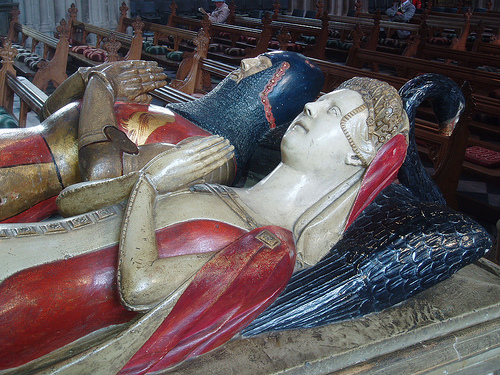
In Worcester Cathedral, this is believed to be the tomb of Sir John Beauchamp and his wife Joan.

Originally I’d planned to drop Tony and the kids at my Dad’s home and make the trip to see Mum alone.  I wanted to see how she was (translation: how did she look) so I could prepare the children. It was a story and SMS from my cousin, Heather, that changed my mind.

A friend of hers had made a similar trip many years before. But instead of going direct to see her Mum in hospital, she went to the family home to settle her young children and have a rest. During that time, her Mum passed away and she didn’t get to see her alive. My cousin said it took years for her friend to forgive herself. “I’d just hate for you to have to experience that, especially after all you’ve gone through to get the kids’ passports and get there quickly,” she told  me.  Her SMS to me when we landed in the UK was another, specific request to do so.

Based on when my Mum died, I could have taken the detour.  Yet I’m incredibly glad we didn’t. ‘Preparing’ the children was simply my excuse to try and delay the inevitable. I will write another post about children, funerals and death, given grandparents are typically their earliest exposure to the end of a human life.  How our two dealt with it was with a matter-of-fact calm that was inspiring – and gave me much needed lighter moments. Like the time we told Miss G (then 5) we had to go to England because Grandma was dying. “Will she look like this?” she asked, dropping her head to a left angle, rolling her eyes back, opening her mouth and letting her tongue hang-out whilst making an odd choking sound. Umm, hopefully not, darling.

Giving Someone Permission To Die

Only yesterday, I was reminded of a letter I wrote my Mum. A reader of this blog contacted me because her own mother is undergoing treatment for stage three cancer. Her fear is having to watch her Mum suffer ‘at the end’.

Mum’s dying is another post, but I do honestly believe the suffering is on the side of those being left behind. In Mum’s case, she experienced no pain and didn’t require IVs of morphine. She was not in the best of health before the cancer diagnosis. Nothing life-threatening, but a series of symptoms and illnesses that slowly, inexorably, diminished her quality of life. I worried about the impact radio and chemo treatment would have upon her already compromised immune system.

imagesSo what I did, five months before,  was write her a letter saying if, at any point, she decided it was all too tough, too hard, then it was fine with me if she chose to stop treatment. To stop exerting a will to live.

To know my Mum, the disabilities she dealt with for over twenty years, the heartbreaks of broken marriages, was to know how perfectly capable she was of ‘soldiering on’. That was her story. But in March, just in case this treatment didn’t work, I wanted to leave her the other, unspoken path. That if I could show acceptance of the possible worst, perhaps she could accept it too.

It was the hardest letter I’ve ever had to write. I told her how  proud I was of her, how amazing she had been – and would continue to be – but if it ever got too much I would understand if she wanted to stop fighting.

Whilst the treatment went well, better than anyone had hoped, when we received the news that the cancer had spread and Mum was facing palliative care rather than cure, I expected her final days to be very different. She was so stubborn, so determined, I feared her lingering for days and weeks.

I’d forgotten about the letter I had written. Today I believe it made a massive difference to how my Mum faced the end of her life. When we arrived in England, I discovered she had already begun the task of packing away precious mementoes she wanted me to have. Putting a memory box together for her grandchildren. The treatment may have gone well, but she’d obviously, quietly, decided that if the worst diagnosis came, she would be  prepared.

In the three to four weeks leading up to the anniversary of her death, I found myself asking, “Would she have known now?” Even without a diagnosis, did she feel the time was approaching? And if so, why didn’t she tell me?

And then I realise, it was both all about me and never about me. If she had an inkling, she wasn’t going to worry me until absolutely necessary. That’s what Mothers do. Protect their young. It was her death to face how she chose. I find a measure of comfort in thinking my letter may have helped her face it more easily.

A big lesson in keeping passports up-to-date

We were packed. My employer had been understanding, telling me to leave and make contact as soon as I knew anything. Tony’s employer less so, not quite making the connection why – as it was my mother, not his – he needed to leave in such a hurry. The topic of grief in the workplace is a blog for another day.

australian-passport_The evening before I went to check-in online. And experienced a soul-destroying panic when I went to put in our passport details. Both of the children’s passports had expired about four weeks before. It was close to 6pm and I literally could not think. I managed to speak to someone in immigration who would not believe I had been able to purchase flights online without entering details. I didn’t care that lastminute.com had a flawed system, I just needed two bloody passports! It got worse, unlike adult passports, the kids needed a brand new application to renew. Where would I get passport photos at 6pm?  Thank God (or whomever you ascribe random luck to) for Google, online services for printing our applications, and the wonderful pharmacist at Rockdale who stayed open late for me to skid in with the kids. When he told me that he’d only listed passport photos on a special search site only the day before, I knew, somehow, somewhere, some benevolent spirit was helping us.

It didn’t stop my sheer terror that we’d miss the flights though. Virgin Atlantic told us we had until 1310 at the absolute latest the next day to make the flight. Tony calmed me, saying I could leave the next day and he would follow with the kids, but, bizarrely, that made me even more upset. The irrationality of grief; suddenly the thought of facing a 24hr flight alone became overwhelming. Seriously – most mothers would jump at the chance to fly 24hrs without their 7 and 5 yo and enjoy movies uninterrupted. Indeed I had done so five months earlier! But this time was different. I needed my family unit around me.

The next day was organised with military precision. I left crack of dawn to be at immigration offices when they opened. Bags and kids stayed with Tony who would meet me at the airport at normal check in time. I was playing by the belief that if we just stuck to the schedule, it would all work out fine.

Bursting into hiccuping sobs in front of the immigration desk probably wasn’t my best look. They made no promises, but put the children’s passports on express — which is normally with 2-3 working days. You can rant about bureaucracy as much as you like, but I experienced nothing but support and compassion. The passports were turned around in three hours. A stressful, fingernail-biting wait, with more tears when they handed them over,  but I made the airport with time for a calming G&T before the rest of the family arrived and we embarked. Not only did the rush, the stress and the race keep me distracted, it gave me special insight into what was to become a constant theme over the coming days and weeks. The kindness of strangers.